


Old Testament Background History] Politics and Religion in the Age of the Kings Through the Lens of Archaeology

1. Introduction: The Impact of Historical Context on the Authority of Preaching
For modern preachers, studying biblical background history is not merely listing facts—it is a core tool that grants “strategic authority” to the proclaimed Word. When we prove that the biblical record is not mythical discourse but “historical reality” inscribed on cold stone and rough pottery fragments, the depth of preaching changes dramatically.
The Books of Kings can easily be read in a flat way due to the numerous kings’ names and complex international situations. However, archaeological artifacts such as the Tel Dan Stele, the Kuntillet Ajrud inscriptions, and the Samaria Ostraca expose the “hidden meanings” behind the text, allowing us to reconstruct in three dimensions the spiritual state of the Israelites and the political tensions of the time. Establishing this historical factuality enables preachers to proclaim biblical truth with greater confidence, while delivering a powerful impact to the congregation that the recorded Word connects to today’s reality.
2. The Tel Dan Stele and the Rise of Hazael: The Historical Reality of the House of David

The fragments of the stele discovered near the gate of Tel Dan in 1993 are considered one of the most important finds in biblical archaeology. This victory inscription was erected by the Aramean king Hazael after defeating Israel in war, and it contains the first extra-biblical mention of “Beit David” (House of David), confirming the historical existence of the Davidic dynasty.
- The Name and Ideological Distortion of Hazael
The name Hazael means “El (God) has seen/permitted.” Yet despite the piety of his name, he was a ruthless usurper who assassinated his predecessor Ben-Hadad and seized the throne. In the inscription, Hazael describes himself as “the one whom Hadad himself made king.” This shows that Hazael attempted to cover the lack of legitimate succession with religious ideology of divine election—beautifully contrasting with the biblical account where Elisha prophesied his rebellion (2 Kings 8).
- “Struck (Strike)” vs. “Killed”: The Tension in the Records
The stele records that Hazael “struck” the Israelite king Joram and the Judahite king Ahaziah. In contrast, the Bible testifies that Jehu killed both kings. Preachers must understand the “nature of dedicatory inscriptions”: Hazael was using ideological exaggeration by claiming as his own (and his god Hadad’s) achievement what was actually done by his subordinate or ally Jehu. This illustrates how pagan kings manipulated their authority through victory stelae, while paradoxically proving the meticulous accuracy of the biblical record.
[Comparative Analysis] Biblical Record vs. Tel Dan Stele Record
| Aspect | Biblical Record | Tel Dan Stele Record | Significance |
|---|---|---|---|
| Accession to Throne | Elisha’s prophecy & assassination of Ben-Hadad | Hadad himself made me king | Usurpation justified by divine authority |
| Warring Parties | Joram (Israel), Ahaziah (Judah) | King of Israel (rm), King of the House of David (yahu) | Proof of the existence of “House of David” |
| Agent of Death | Jehu killed both kings | Hazael claims he “struck” both kings | Hazael’s ideological victory report |
| Military Status | Israel suffering under Aramean oppression | Advance through Israel all the way to Gath | Complete neutralization of Israel & spiritual crisis |
3. The Black Obelisk and Jehu’s Humiliation: Israel in International Context
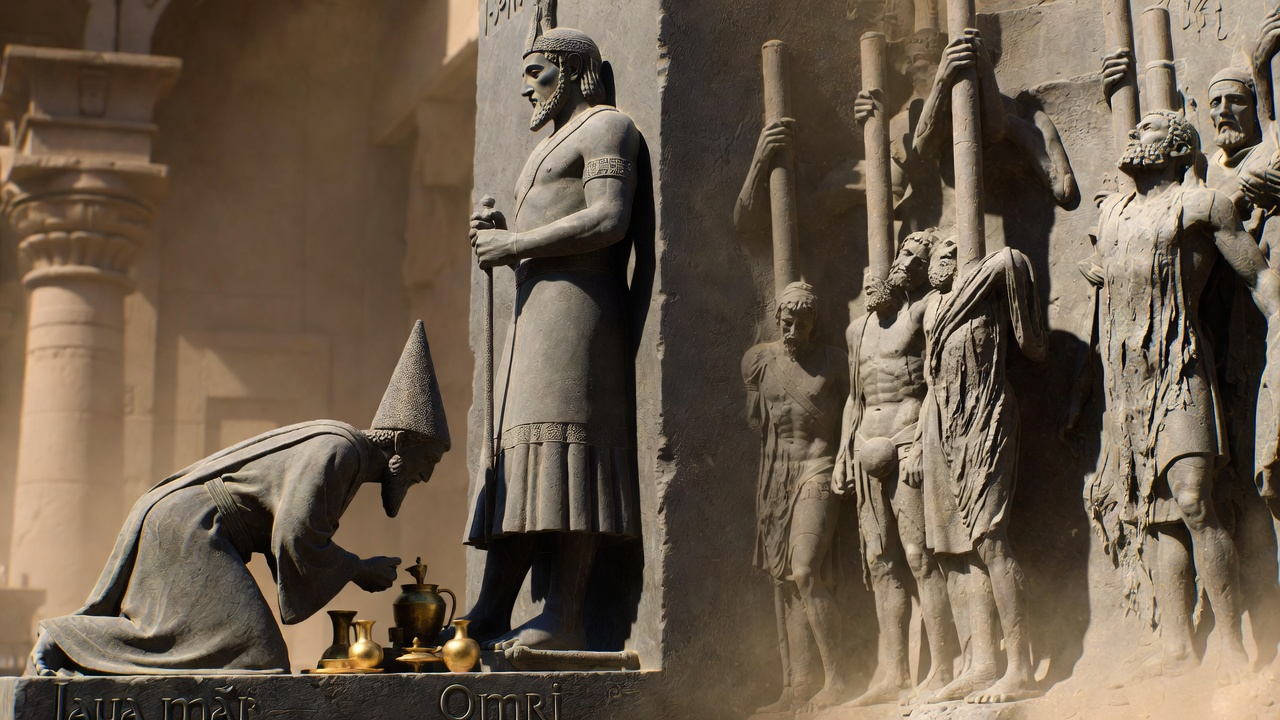
The Black Obelisk of Shalmaneser III reveals another side of Jehu, known as the reformer of northern Israel. The inscription vividly depicts Jehu prostrating himself and paying tribute before the Assyrian king.
- The Paradox of “Jehu son of Omri”
The Assyrian inscription calls Jehu “son of Omri.” Although Jehu destroyed the Omride dynasty, the international community still recognized Israel under the powerful brand name “House of Omri (Bit-Humri).” This suggests that while Jehu’s religious reform may have eradicated Baal worship internally, externally it isolated Israel politically and forced humiliating tribute diplomacy. It illustrates the precariousness that arises when thorough spiritual reform is not combined with international political wisdom.
4. Kuntillet Ajrud Inscriptions: The Pollution of Yahwism and Syncretism
The artifacts discovered at the desert trade-route site of Kuntillet Ajrud expose how grotesquely corrupt Israelite spirituality had become. The phrases “Yahweh of Samaria and his Asherah” and “Yahweh of Teman and his Asherah” found there shock modern preachers.

- Localization of Faith and Functional Idolatry
The people fragmented the one true God into “Yahweh of Samaria” and “Yahweh of Teman,” reducing Him from universal sovereign to a “functional deity” responsible for regional fertility and well-being. Drawings on the pithoi—Bes-like figures, bull/calf motifs reminiscent of Hadad, harp-playing women—provide evidence of spiritual adultery that mixed the holy God with pagan imagery.
- High Places (Bamah): The Social Media Hub of Daily Life
The “high places” frequently mentioned in Scripture were usually located at city gates. Gates served as today’s “social media/village hubs” where people gathered to exchange information and conduct business. People did not go out of their way to sin; rather, they bowed to idols “in passing” at the very center of everyday social life.
• Visibility: They indulged in the visual comfort of golden calves or Asherah poles over the invisible God.
• Desire for Prosperity: They replaced the personal sovereign God with a “functional tool” that dispenses blessings like checking a stock chart.
• Everyday Idolatry: Just as smartphones are internalized into modern life, high places became their very lifestyle.
5. The Prosperity of Jeroboam II and the Samaria Ostraca: Corruption Behind the Boom
The era of Jeroboam II was the greatest territorial and economic golden age since Solomon, yet the Samaria Ostraca (administrative pottery shards) testify that this prosperity rested on the luxury and exploitation of a small ruling class.

- The Daughters of Zelophehad and Historical Reality
Names of clans such as “Yaziel” and “Adoniram” appearing on the Samaria Ostraca match clan names related to the daughters of Zelophehad (tribal land distribution) in Numbers 26 and 36. This powerfully proves that the biblical land allotment records were not mere genealogies but continued to function as actual administrative units centuries later.
- The Reality of Winter and Summer Palaces
The “winter house and summer house” and “beds of ivory” condemned by Amos are archaeologically confirmed through excavations of the luxurious Samaria palace. The elite consumed “choice wine” and “fine oil” extravagantly while oppressing the poor. The modern person constantly checking smartphones and stocks like a “functional god” mirrors the self-portrait of Jeroboam II’s era—losing God at the peak of prosperity.
6. Assyria’s Standing Army System and the Instrument of Judgment: An Irresistible Historical Wave
When Israel’s internal corruption reached its extreme, God used Assyria—the ruthless “rod of judgment.”
- The Terror Machine and Organizational Analysis
• Standing Army System: Maintained elite forces capable of year-round campaigns over a 3,000 km radius, independent of farming seasons.
• Rabshakeh and Tartan: As in Scripture, “Rabshakeh” is not a name but the title “Chief Cupbearer,” and “Tartan” means “Commander-in-Chief.” These were often loyal elite officials of eunuch origin who formed the backbone of Assyrian administration and military.
• Eponym Chronicle: Assyria kept precise year-by-year chronicles, which—cross-checked with astronomical events like solar eclipses—serve as anchor points for biblical chronology.
Assyrian kings left reliefs of flaying skin or impaling victims as “terror marketing.” This symbolizes the cold historical reality awaiting a people who abandon God.
Conclusion & Guide for Preachers: “So What Will You Proclaim?”
Archaeological data are not mere fragments of the past—they are “certain evidence” for the Word proclaimed from today’s pulpit.
- The Authority of Faith Built on Historical Factuality: Just as the Tel Dan Stele proves the Davidic dynasty, proclaim that the God we believe in is not an abstraction but the Lord of history.
- Beware of Idols Internalized into Daily Life: Like the Kuntillet Ajrud inscriptions, expose the syncretism of “functional gods” (smartphones, wealth) deeply embedded in modern life.
- Trust in the Sovereign of Judgment and Salvation: Even before mighty Assyria’s standing army, God heard Hezekiah’s prayer—emphasize decisive faith over humanistic diplomacy in times of crisis.
When using photos of artifacts or maps in sermons, do not treat them merely as historical lecture aids. Instead, capture the theological tension between “human stubbornness” and “God’s faithfulness” that the artifacts testify to, turning them into living words that pierce the hearts of the congregation.
May this guide strengthen and enrich your pulpit ministry. Blessings!
'신학공부 > 구약' 카테고리의 다른 글
| 기도가 막힌 당신에게, 나는 시편을 권합니다 (0) | 2026.03.10 |
|---|---|
| 묵시문학의 역사관점: 위기 속의 결정론적 세계관과 상징적 재해석 (0) | 2026.03.06 |
| 고고학으로 본 열왕기 시대: 오므리 왕조, 쿤틸렛 아주르 종교혼합, 앗시리아 침공, 텔단 석비와 하사엘, 검은 오벨리스크, 사마리아 오스트라카 (0) | 2026.02.21 |
| 구약성경 배경지식-말라기 (2) | 2026.01.20 |
| [구약성서배경사] 다윗 왕조는 실제로 존재했을까? (1) | 2026.01.11 |